Cash moves through your checkouts every day, placing real pressure on the employees who handle it. Judging a potentially counterfeit banknote while a queue builds or worrying about cash sitting in an open drawer for too long are everyday challenges that much retail technology does little to address.
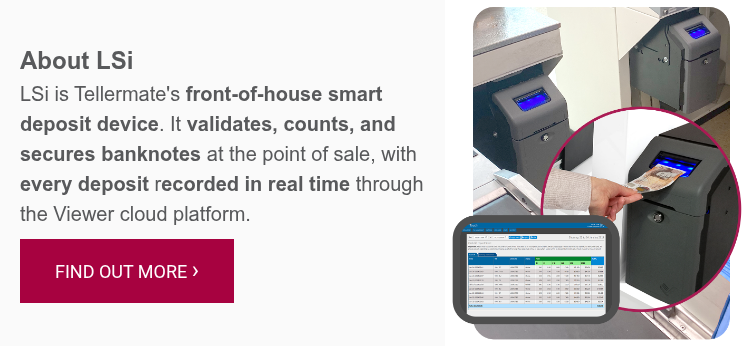
Tellermate LSi is a front-end deposit device that validates, counts, secures and records banknotes as they are received at the checkout, with no POS integration required.
Now, let’s take a look at ten issues in your cash cycle and how LSi can effectively take them out of the equation.
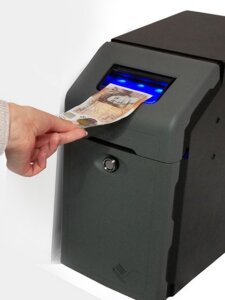
A customer may unknowingly try to pay with a counterfeit banknote, or knowingly attempt to pass one off as genuine. If the note is questioned by the cashier, the customer may become demanding or argumentative, putting pressure on the cashier to accept it.
With LSi in place, received banknotes can go straight through validation. If something is wrong, the note comes back indicating an issue. The cashier does not need to make a judgement callunder pressure, and there is no difficult moment with the customer. The device decides, consistently and every time, with detection technology approved by the Bank of England and ECB.
Imagine it is a peak trading period – from the busy gardening season and end-of-summer sales to Halloween, Black Friday or Christmas. Higher footfall means more transactions and potentially more cash passing through each till. If high-value banknotes are left in an open drawer, this can increase the risk of snatch theft and other attempted theft. Minimising that exposure is an important part of protecting both employees and the business.
As soon as a note is deposited into the LSi, it is counted and recorded. High-value cash is off the till within seconds. The drawer does not accumulate high value banknotes or too many of one denomination through a shift the way it would in a manual process. This is usually where supervisors get pulled off the floor mid-trade to do an unplanned skim. But, with LSi notes can be put away securely and accounted.
When a note that gets through the first manual check it may not get a second one. Once it is accepted into the drawer, it is in the queue for the banking process causing cash loss to your business.
LSi validates at the moment of receiving cash from the customer, which means the check happens at the only moment it can actually catch something and prevent this kind of cash loss.
 When cash deposits rely on manual entries or printed records, time can pass between the original count, the recorded entry and the final recount at the bank. The same uncertainty applies to banknotes that should have been placed in a dumb drop box at the till: was the note actually deposited, and was the deposit recorded correctly? The more time that passes before a discrepancy is discovered and investigated, the harder it becomes to establish what happened.
Now, with LSi, each note is logged by denomination, user, and time. When something does not reconcile, the record already exists. Investigations that used to mean CCTV trawls and uncomfortable conversations can often be resolved in minutes. Staff who handle cash honestly benefit from that audit trail as much as the business does.
Counting and recording cash lifts and the money held in the safe can take considerable time. During trading hours, this can be especially inconvenient for stores operating with limited staff. At the end of the day, managers may also have to stay late to make sure every count has been completed and recorded correctly. Across multiple stores, that additional management overtime can become a significant cost to the business.
Because LSi counts and records banknotes throughout the shift, closing the till becomes a lift-and-log process rather than a supervised recount. In a manual process, one till discrepancy or an incorrect safe count can delay closing and hold back the whole team. LSi reduces that dependency because the contents of each cassette have already been counted and logged.
Retailers often recruit additional seasonal employees during their busiest trading periods. New starters may be unfamiliar with the store’s equipment and processes, and training them takes time away from more experienced colleagues. Equipment that is easy to use – supported by short, accessible training materials – can therefore make a real difference.
The LSi workflow is straightforward: the cashier inserts the banknote and the device handles the validation, counting and recording. There is no complicated technique or lengthy routine to remember under pressure. This is particularly valuable in high-turnover environments, where training time is limited and the risk of inconsistent processes is greater. Tellermate can also provide LSi onboarding videos for employees at every level, helping stores deliver training consistently.
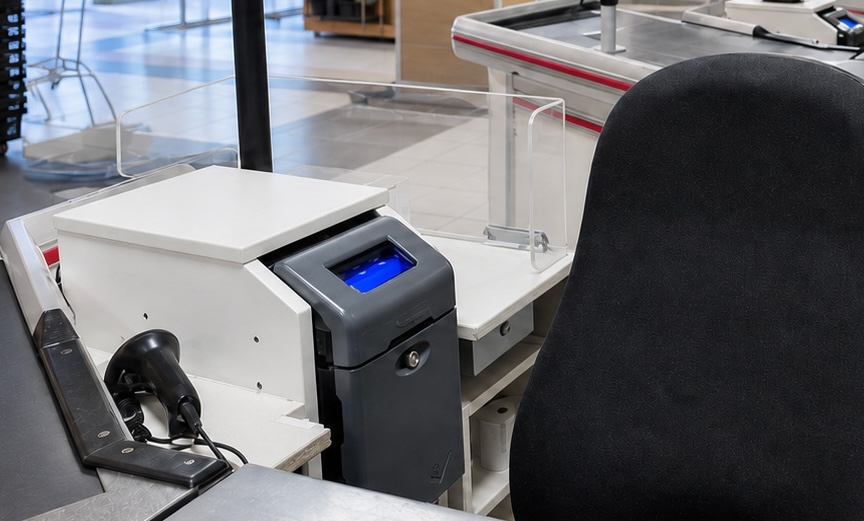
IT departments are often balancing multiple projects, and implementing new technology can require considerable time and resources. Operations teams do not want useful store equipment to be delayed because deployment depends on complex technical work.
LSi requires no POS integration, and installation does not disrupt checkout infrastructure. For retailers put off by the footprint and integration requirements of traditional cash recyclers, that is a significant practical difference. LSi even offers several bracket options to suit retail chains with different the checkout environments.
This is about being able to investigate discrepancies and see cash trends quickly. Can Operations and Loss Prevention teams see cash activity across every store? Without visibility of deposit activity by checkout lane, cash-lift records, timestamps and user details, it can be difficult to identify where and when a discrepancy occurred. The more relevant data teams have – and the more clearly it is structured – the faster they can investigate an issue.
LSi feeds deposit data into Viewer, Tellermate’s cloud-based cash journal platform, in real time, but can also keep a local log. Operations and Loss Prevention teams can see what is happening across all stores without calling anyone. Patterns that used to take weeks to surface become visible much sooner.
If you don’t know how much cash each store is holding, how can you plan the most cost-effective way to collect it? Retailers may use the same cash-in-transit (CIT) collection schedule across multiple stores or regions, even though cash intake can vary significantly by location. Seasonal trading periods can create further fluctuations.
With real-time cassette totals available through Viewer, collections can be planned around actual cash levels rather than fixed schedules. For retailers running regular pickups, that visibility often supports reducing frequency. Now, thanks to LSi retail teams can better identify pattern in cash-heavy stores that may require an increased collection schedule or when seasonal shopping brings in more cash. And the same goes for less cash-heavy stores requiring less frequent collections.

Some of our customers have historically used a separate safe bag for every cashier’s drop box on every shift. Although this provides cashier and lane-level accountability, the cost of those consumables can quickly add up across a store estate. LSi provides that accountability through its data and audit trail, giving retailers an opportunity to reduce their reliance on single-use bags – and the associated environmental impact.
LSi secures banknotes in a reusable tamper-evident cassette, removing the need to place every note deposit into a separate safe bag. Each cassette removal is logged, including who removed it, when it was removed and the value recorded inside.
Depending on the retailer’s security process, access to the cassette contents can be restricted to the CIT provider. Alternatively, an authorised manager can consolidate the contents of multiple cassettes into fewer safe bags ready for collection, rather than using a separate bag for every drop box.
For cash-heavy stores that must remain below a specified value per safe bag, Viewer can help teams group cassette totals without exceeding that limit. The saving may appear modest at one location, but it can become significant when multiplied across an entire store estate over the course of a year.
LSi does not change how a checkout works. It simplifies and optimises the whole cash process from the till to the bank.
These ten points reflect where cash handling can often go wrong, and where LSi can genuinely make a difference to the process, loss prevention and visibility of cash. The LSi front-end deposit device can also be used alongside the Tellermate Touch money counter as a complete cash cycle solution to include coin/bag counts and till counts, or on its own where front-end security is the priority.